Use case
Client request management for service businesses
Catch every client request in one place — instead of email, Slack and texts you have to stitch together yourself.
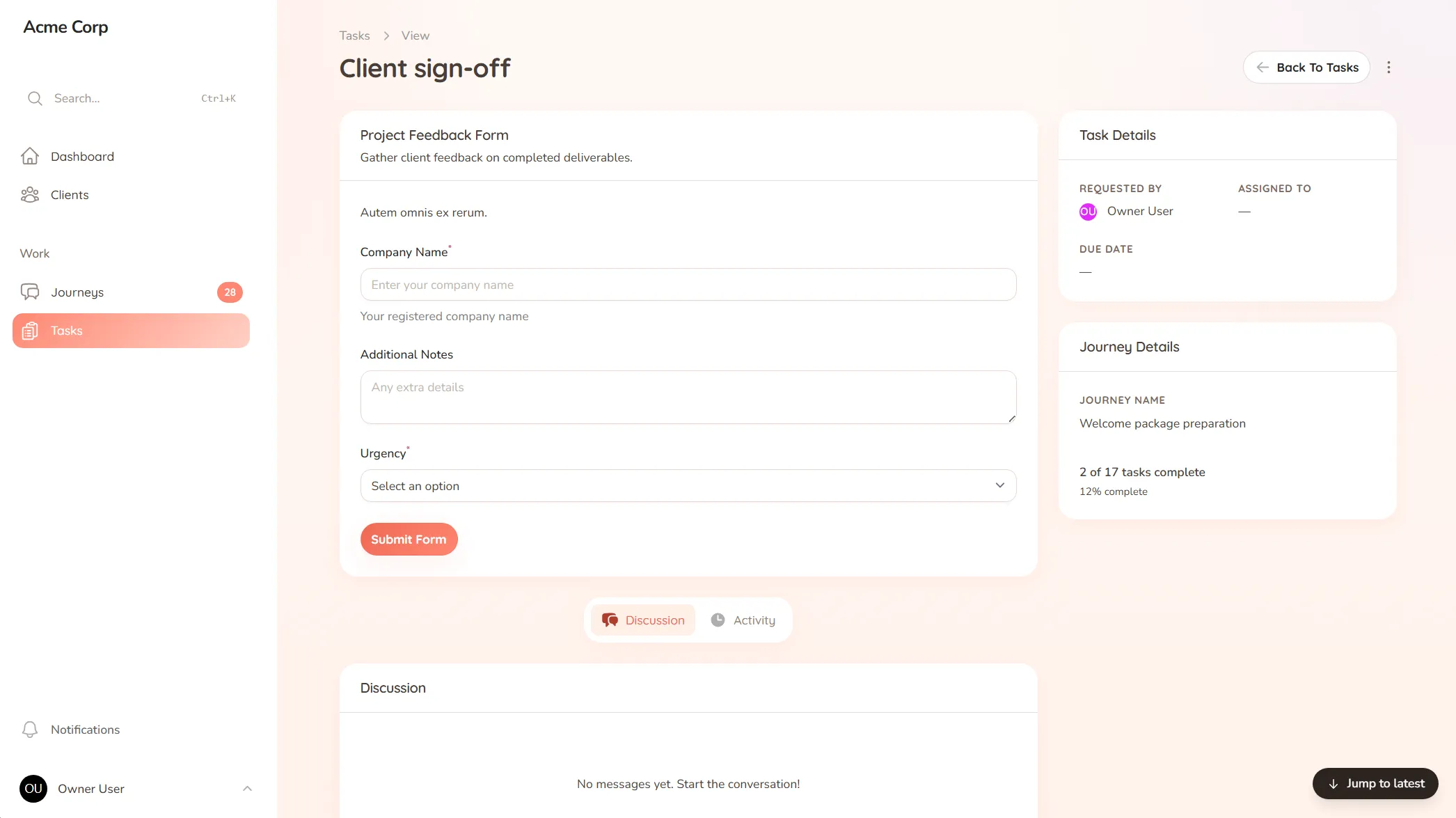
Catch every client request in one place — instead of email, Slack and texts you have to stitch together yourself.
A client mentions a change in passing on a call. Another sends it by text. A third buries it in the third reply of a thread about something else. None of it is written down in one place, so the moment you get pulled into other work, one of those asks quietly disappears — until the client follows up, a little less patient than before.
It’s not that anyone dropped the ball on purpose. Requests arrive through every channel you own — email, Slack, phone, the odd Post-it — and no single one of them is the record. You spend real time each week just working out what was asked, by whom, and whether it’s been done.
StellaJourney gives your clients one place to send requests, and gives your team one place to catch them.
A request can be a quick note, a file upload, or a form — so clients hand over exactly what you need to act, not a one-liner you have to reply to three times for the details.
Client request management is not just about capturing messages. It is about making the request clear enough that someone can act on it without reconstructing the conversation first. A request that says “can you update this?” still leaves your team asking which file, what change, by when, and who approves the result.
StellaJourney gives each request a home. The client, task, files, form responses, discussion, and status stay together. If a team member picks it up tomorrow, they can see what was asked and what has already happened. If the client comes back next week, they can see the request in the same place instead of forwarding the original email.
That shared record is what stops small asks becoming operational debt. The work does not depend on one person remembering who said what on a call. It sits where the team can see it.
An inbox is ordered by when a message arrived, not by what needs attention. That is fine for communication, but weak for client work. The important request is not always the latest email. It might be the overdue file, the unanswered form, or the approval holding up three other tasks.
StellaJourney surfaces requests as work, not just messages. New items and overdue items are visible in one place. Clients still have a simple way to ask for help, but your team gets a structured view of the work behind those asks.
A web agency might use it for content requests and bug reports. An MSP might use it for access changes. A consultant might use it for stakeholder feedback. An accountant might use it for document follow-ups. The request type changes, but the pattern is the same: the client asks, your team needs context, and both sides need to know where it stands.
This isn’t a help desk built for a 500-seat support team, and it isn’t a CRM. It’s the shared space between you and your clients — so the next request lands somewhere you’ll actually see it, and nothing falls through the cracks.
Every task across every journey, grouped, filtered, sorted by priority and due date.
Three task types, simple todo, file upload and structured form, so work is collected in the right shape.
Clients raise new requests from the portal without seeing internal setup fields or staff-only structure.
Stale or unassigned work bubbles up automatically, so nothing slips through the cracks.
Every user picks which notifications they get in-app and by email, tailored to their role.
One page that holds details, intake data, files, conversation, tasks and history for every piece of client work.
Clients submit requests from their own portal, so every ask lands in the same place with the context attached. No more pulling requests out of email, Slack and voicemail and hoping you caught them all.
New and overdue requests surface in one queue, sorted by what needs attention first. You glance at it once and know what's waiting, instead of trusting your memory.
Yes. Clients see where their request stands without emailing to chase it, which cuts the "any update?" messages that interrupt your day.
A request can carry a file upload or a form, so clients send what you actually need in the format you need it — not a vague message you have to reply to for details.
Client portal for MSPs
Onboard new accounts, catch every request, and keep client-facing work organised — one shared space for your MSP and its clients.
A client portal built for marketing agencies
Onboard new accounts, gather briefs and assets, and keep campaign approvals moving — without the email pile-up.
Client portal for web development agencies
Onboard projects, collect content and requirements, and keep feedback in one place — instead of chasing assets across email and Slack.
Client approval workflow software
Request and track client sign-offs right on the work — instead of hunting for a yes across a dozen email replies.
A client communication tool that keeps context
Keep every client conversation tied to the work it's about — instead of scrolling 40 emails to find the one reply that mattered.
Client onboarding software for service businesses
Give every new client the same clear, structured start — instead of a different scramble every time.
Set up your first journey, invite a client, and see how it feels.