For your industry
Client portal for consultants
Onboard engagements, keep deliverables moving, and get clean milestone sign-offs — one shared space for you and your clients.
Onboard engagements, keep deliverables moving, and get clean milestone sign-offs — one shared space for you and your clients.
What you onboard
Client goals, project scope, stakeholders and the background documents you need before an engagement can start.
Typical requests
Deliverable reviews, milestone approvals, and the recurring asks for data, feedback and decisions that keep a project moving.
The engagement started clear. Then a stakeholder added “just one more thing” on a call, the client’s idea of done drifted from yours, and a milestone you thought was approved turns out to be “still being reviewed by the team.” Now you’re delivering against a moving target, and the conversation about what was actually agreed is spread across email, call notes and a deck nobody’s looking at.
Consulting lives or dies on shared understanding. When goals, deliverables and sign-offs aren’t held in one place, scope creeps, decisions get re-litigated, and you spend billable thinking time reconstructing what everyone agreed to.
StellaJourney gives you and each client a shared portal where the engagement — goals, deliverables, and decisions — lives in one place instead of scattering.
Each engagement has its own workspace — we call it a journey — so one client’s work never bleeds into another’s, and you can see where every project stands without opening five tools.
Most consultants already have a way to manage their own work. The problem is the edge between your work and the client’s decisions. That is where discovery notes, background documents, feedback, approvals, and next steps often get split between email, meeting notes, and a shared drive.
StellaJourney gives that client-facing layer a clear home. You can keep your internal analysis, planning, and delivery process private, while giving the client a simple place to provide what you need and approve what is ready.
That makes the engagement easier to manage without turning the client into an internal team member. They see the work that needs their input. You see the context and status behind it.
Consulting engagements often involve more than one stakeholder. The person who approved the scope may not be the person reviewing the deliverable. The sponsor may want status, while the operational contact is the one sending documents. When those roles change mid-project, the record matters.
Because requests, discussions, and sign-offs stay with the engagement, a new stakeholder can catch up without asking you to resend everything. Your team can also protect its own time: fewer recap emails, fewer repeated explanations, and fewer debates about what was approved.
It also gives you a cleaner way to run the quieter parts of the engagement. Background documents, stakeholder inputs, review comments, and meeting follow-ups can all sit in the same client workspace. That means the project record is not split between your notes and the client’s inbox.
For solo consultants, that creates a more professional client experience without adding an operations team. For small firms, it gives every consultant the same client-facing process, so the quality of the engagement does not depend on who remembered to send the follow-up.
It isn’t an internal delivery board and it isn’t a CRM — it’s the client-facing space that keeps an engagement aligned, priced flat with no per-seat fees.
Use it for kickoff, discovery requests, deliverable reviews, milestone approvals, and the decisions that happen between meetings. Scope stays shared, sign-offs stay clean, and nothing falls through the cracks.
Reusable journey blueprints with workflow, intake fields, sort order and starter tasks.
Clients approve work waiting on sign-off, or send it back with feedback when revisions are needed.
Staff and clients message back and forth inside the journey, with formatting, mentions and notifications built in.
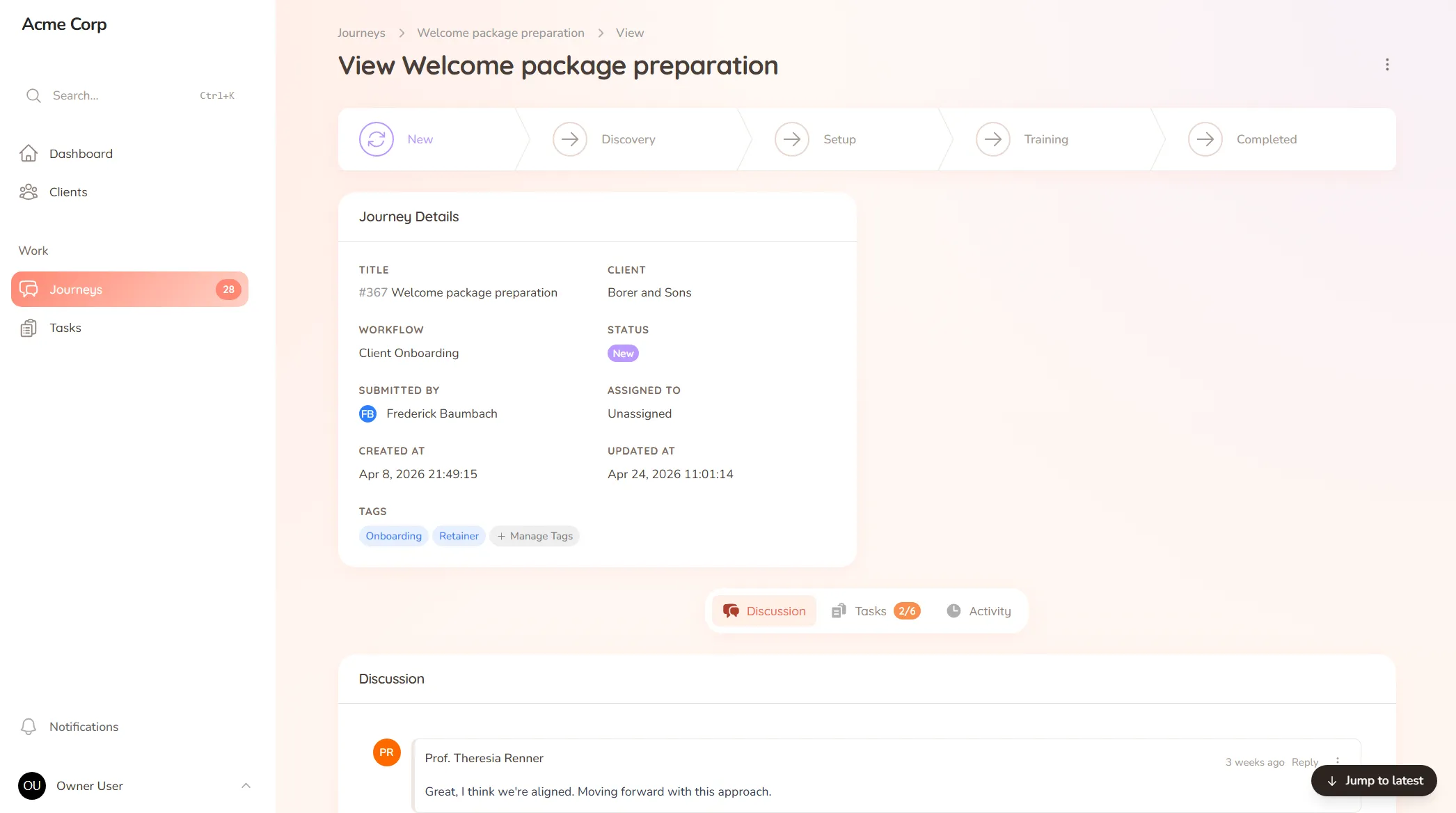
One page that holds details, intake data, files, conversation, tasks and history for every piece of client work.
Every user picks which notifications they get in-app and by email, tailored to their role.
Clients are invited in and land in the right portal, whether they're a brand-new user or an existing one.
No. Asana and Monday run your internal delivery, with clients bolted on. StellaJourney is the shared space between you and the client — onboarding, deliverable reviews and sign-offs that both sides actually use.
A sign-off is requested right on the deliverable, so the client sees what they're approving and responds in one place. You always know which milestones are signed off and which are still waiting.
Yes. Each engagement gets its own workspace, so the goals, deliverables and conversation for one client stay separate from the next — and you see where each one stands at a glance.
Messages live with the deliverable or task they're about, so the context behind a decision stays put instead of scattering across email and call notes.
Client onboarding software for service businesses
Give every new client the same clear, structured start — instead of a different scramble every time.
Client approval workflow software
Request and track client sign-offs right on the work — instead of hunting for a yes across a dozen email replies.
A client communication tool that keeps context
Keep every client conversation tied to the work it's about — instead of scrolling 40 emails to find the one reply that mattered.
Client task management for service teams
Track every task on both sides of the client relationship — so you always know what's done, what's pending, and who's waiting on who.
Client portal for accountants
Collect financials and tax documents, onboard new clients, and stop chasing paperwork — one client portal for your firm.
Client portal for architects
Collect site briefs, keep design revisions tidy, and get clear sign-offs — one shared space for your practice and its clients.
Client portal for coaches
Onboard clients, set and track session work, and keep progress in one place — one shared space for your coaching practice.
Set up your first journey, invite a client, and see how it feels.